Introduction
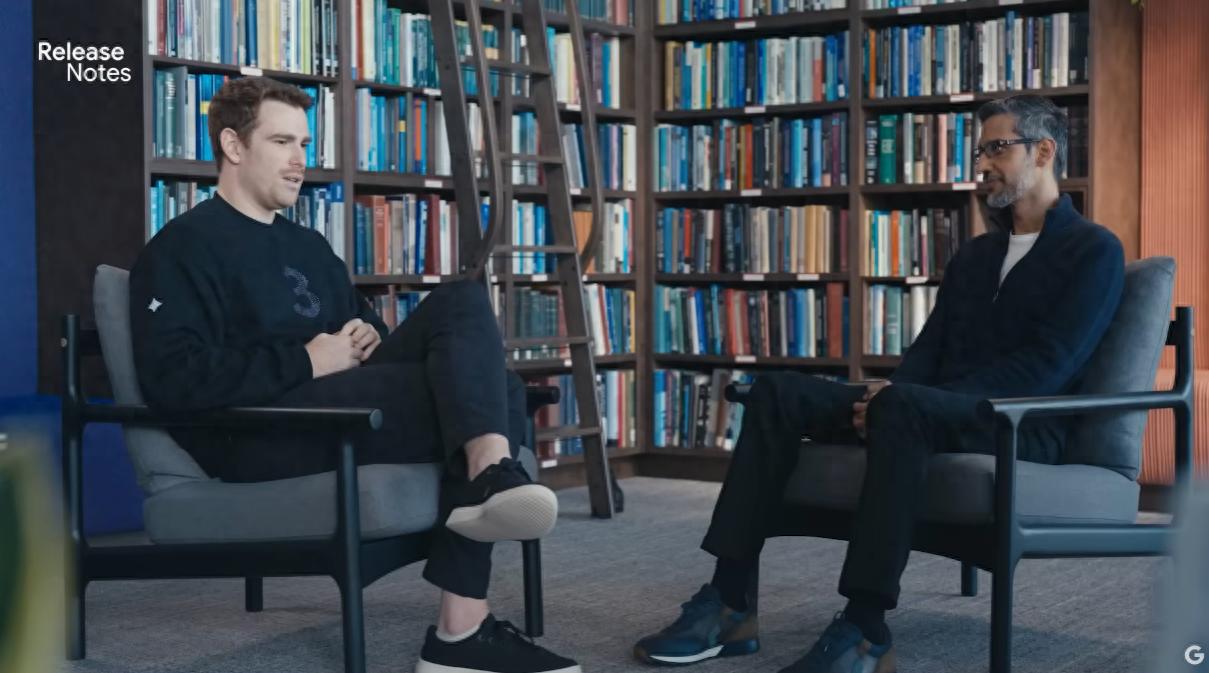
On November 26, Logan Kilpatrick from Google DeepMind engaged in an in-depth conversation with Google CEO Sundar Pichai. They discussed the release of Gemini 3 and Nano Banana Pro, as well as Google’s overall momentum in AI development. Pichai highlighted Google’s long-term investments in infrastructure and the rise of Vibe Coding, sharing his outlook on the future of quantum computing.
AI-First Strategy
Pichai revealed that Google established its AI-first strategy back in 2016, driven by breakthroughs from Google Brain, the introduction of DeepMind, and the success of AlphaGo. This long-term perspective has allowed Google to achieve an innovation stacking effect at every layer of its tech stack, from infrastructure optimization to model training and product application, creating a complete technological loop. He emphasized that Google’s full-stack innovation from chips to applications is generating a multiplicative effect, with Gemini becoming the core link across all product lines.
Nano Banana Pro and Vibe Coding
The recently launched Nano Banana Pro has sparked enthusiastic responses in the market, showcasing users’ incredible creativity through infographics created with the model. Pichai believes this reveals the latent creativity within people, with Google providing tools for more individuals to express their ideas. He specifically mentioned the phenomenon of “Vibe Coding,” where AI is lowering the barriers to programming, enabling non-technical individuals to create applications, akin to the impact of blogs and YouTube on writing and video creation.
Quantum Computing Outlook
Additionally, Pichai discussed advancements in quantum computing, expressing optimism that in about five years, we will be incredibly excited about quantum technology, similar to our current feelings about AI.
Key Points from the Conversation
- The 2012 Google Brain’s “cat paper” achieved breakthroughs in image classification; in 2014, Google DeepMind was introduced; and January 2016 marked the moment of AlphaGo. In May 2016, Google announced its first TPU, marking a pivotal moment for the company as it transitioned to an AI-first approach.
- Adopting a full-stack approach means that innovations at every layer permeate the entire system, creating a multiplier effect.
- Gemini serves as a tangible link connecting all of Google’s products, from Cloud to Waymo to Search.
- Nano Banana Pro has crossed the chasm, particularly in infographics and fact-checking in conjunction with Google Search, aligning with Google’s mission to organize the world’s information and make it universally accessible.
- Developers are excited about Flash, as it enables them to serve more people. Pichai believes 3.0 Flash will be an excellent model, possibly the best yet.
- Quantum computing is a fantastic prediction, with the potential for excitement akin to today’s AI in about five years. By 2027, we might deploy TPUs in space.
- Vibe Coding resembles the rise of the internet, where more people became writers and creators, and this change is palpable even within Google.
Full Conversation
Logan Kilpatrick: Hello everyone, welcome back to Release Notes. I’m Logan Kilpatrick from the Google DeepMind team. Today, we have Sundar Pichai, CEO of Google and Alphabet. We’re in Mountain View. Gemini 3 has been released, and Nano Banana Pro is out with very positive feedback. So, would you like to summarize this moment of progress for us? Now we not only have top models like Gemini and Nano Banana Pro but also Vo and other music models, blossoming across the board. It feels like the longer we wait, the more emerges. So, I don’t know, do you want to paint a picture of this moment for us?
Sundar Pichai: First of all, it’s great to be here. I want to say this is an extraordinary week. You know, when you’re doing R&D internally, you envision the moment when you can truly showcase all the results. There’s nothing more exciting than that moment when you’re committed to a product. This week reflects that.
But I think this is built on years of foundation and all our deep investments. It’s been clear to me that you can see the speed at which we are making progress. All the seeds have come together, and it’s indeed very special. Just in the past few weeks, I was reflecting that we seem to be releasing new things almost every day. So, it’s a wonderful feeling.
Logan Kilpatrick: Indeed. I remember about a year and a half ago I was chatting with you, and I was complaining about something. I was definitely complaining about something, and you said something that pushed me to look at things from a long-term perspective. I’m curious about how you maintain that long-term view, especially in this highly competitive moment where it feels like an endless race to stay 1% ahead on the leaderboard. Clearly, long-term vision is crucial.
Sundar Pichai: I’ve always forced myself to step back. The pace in our industry is fast, and you want to iterate quickly, and I really enjoy that. But being able to step back, lay out a long-term plan, and stay focused on a long-term goal is always crucial.
In 2016, I wanted the entire company to be AI-first. A large part of what facilitated that moment was the 2012 Google Brain breakthrough, the introduction of Google DeepMind in 2014, and the moment of AlphaGo in January 2016. Then people noticed—many did in May 2016—when we announced our first TPU.
Yes, so in 2016, seeing all this, I was clear we were going to experience another platform shift. That was the bet on the full-stack approach, positioning Google as an AI-first company. Since then, we’ve made significant progress. There have been too many breakthroughs from Google, including Transformer. We’ve applied it to our products, like Bert and MUM, improving search, launching Google Photos, etc.
With the advent of generative AI, I realized the window of opportunity was even larger. People are ready to use this technology at scale, whether consumers, developers, etc. So how do we respond to such a moment? For us, AI means we initiated the Gemini project, spanning Google Brain and Google DeepMind. As part of that, we decided to merge the teams into Google DeepMind, significantly increasing our investments in infrastructure, data centers, TPU, GPU, etc.
Next, you know you need to get the company into a faster rhythm, right? Now that you have the technology, once the GDM team starts releasing Gemini, you can discuss the series of milestones we’ve experienced with Gemini. I’m glad you’ve played a role in many aspects of this journey. Now, how do you ensure it manifests in all our products? Many products touch billions of users, right? How do you iterate search with the capabilities these models can achieve? That’s our journey. But you know, you can step back to understand this framework. It’s very exciting because this is the first time that when you adopt a full-stack approach, every layer of innovation permeates the entire system to the top.
Logan Kilpatrick: That’s how I explain pre-training. DeepMind’s pre-training works remarkably well on Gemma. My model, like post-training, reinforcement learning acts as an accelerator for underlying capabilities. I feel our infrastructure is similar.
Sundar Pichai: Absolutely right. You improve the infrastructure, optimizing model performance in training, testing, and computation. Where do we improve the model? Or how do you acquire those capabilities and reflect them in products, right? How does Nano Banana appear in your products? Generative UI with AI mode in search, right? So, you improve at every level, not to mention providing these improvements to developers, allowing them to innovate on top of that, right? That’s where the multiplicative effect comes from. And all of this is always incredibly exciting. Watching all of this is always thrilling.
But you know, we’ve always had a long-term plan, thinking about how to achieve our goals. Some aspects take time because we adopt a full-stack approach. When we needed to respond to the challenges posed by the AI era, I don’t know, our capabilities were indeed insufficient at that time. So we needed to invest to scale up, ensuring all aspects reach a certain scale to guarantee fixed costs. Therefore, if you stand from an external perspective, you might feel we are progressing slowly or lagging behind. But in reality, we’ve been building all the necessary frameworks and then advancing execution on that basis. Now we have succeeded, and you can see various teams are moving forward rapidly.
Logan Kilpatrick: Yes, seeing all this is incredible. You mentioned Gemini appearing in all our products. I think I was discussing this anchor point with Josh and Tulsi regarding the challenge—I feel some of the challenges facing some of these releases now are synchronizing releases, and it may not even be from a product perspective but from a capacity perspective, and how to ensure models are well presented across all different product experiences. I feel this introduces a new… we almost… I’ve commented on similar things; we’ve nailed the model itself, and there’s clearly more work to do, but deploying them across all Google product interfaces is extremely difficult, which reminds me of this. I had an insight at this year’s I/O, and I want to confirm with you because maybe you have a different view, but historically, apart from your Gmail or your Google account, there seems to be no such thread that connects the entire suite of products Google has, from Cloud to Waymo to Search to all other products like Gmail. And now, it feels like Gemini is that thread, genuinely connecting every one of our products. It feels like something magical is happening. I don’t know your reaction to that.
Sundar Pichai: I think it is Gemini. I know your perspective is great. But for me, Gemini signifies much more. It clearly embodies the essence of the AI-first strategy. Indeed, because now we have tangible, understandable products like Gemini. And you’re right; Gemini can enhance services across the board, from search, YouTube, cloud services to Vemo.
Regarding the release of Gemini 3, one thing I love is that you mentioned synchronized releases. We’ve switched many products in synchrony. But for me, seeing on X, it could be Copilot or Replied or Figma, you know, everyone gathering together, synchronously releasing. Yes, indeed. For me, that’s scalable innovation, right? Not just us, but other companies in the world. Seeing all this is remarkable.
Logan Kilpatrick: Yeah, awesome. Looking at other posts, and that Nano Banana Pro moment, I’m sure you spent quite a bit of time studying this model. People are going crazy for it; it’s fantastic. I must continue…
Sundar Pichai: I can’t help but ask, are we raising the world’s productivity, or merely satisfying entertainment needs? Is this net progress or not? Those infographics look amazing. I believe when we move beyond the entertainment phase, I just saw Ajrim on X posting his core weaving analysis infographic. So, you know, it prompts me to study it closely. Years ago, a problem brought by PowerPoint was that people kept making more and more slides, and I used to collect a lot of information, and the amount of information kept growing. Perhaps with Nano Banana Pro, we return to a tool that can compress information and present it to the world in a more understandable way.
Logan Kilpatrick: Yes, that’s precisely what I was going to say. Historically, I’ve personally been skeptical about how much use many generative media models have for the world. Clearly, from an entertainment perspective, it’s useful, but it feels like Nano Banana Pro has crossed the chasm, especially in infographics and fact-checking in conjunction with Google Search, effectively aligning with what I believe I can clearly see how this becomes part of Google’s mission—to organize the world’s information and make it universally accessible—through those infographics. It shocked me; it was so interesting. I think it’s a good reminder that we will see those use cases. I remember when we created some content, the Nano Banana team mentioned they didn’t even deliberately try to make the infographics look good; it just naturally happened as the model became very powerful, and the text rendering capabilities significantly improved.
Sundar Pichai: That’s interesting. Another thing it shows me is how much latent creativity exists in the world. What we’re witnessing is another wonderful thing: I believe people will express themselves, and we’re providing tools for them to realize their ideas as they envision them, right? So I think otherwise, we’ve been limited by the tools in front of people. You might not realize it, but we’re creating increasingly expressive tools, and they are becoming easier to use for more and more people. So seeing all this, you know, is also incredibly exciting.
Logan Kilpatrick: I have another question about this aspect, but one of the… I have to credit Tulsi. Tulsi suggested I ask you this question while talking to you because she was curious about how you measure the success of these moments when you see these releases and significant moments for Google happening. Is it the online feedback? Is it how the first-day adoption looks? Or how do you measure whether this truly brings change to Google?
Sundar Pichai: You see, on release day, I’m quite active, trying to understand what’s working. I’m looking for feedback, for example, I’m trying to see how ordinary users are experiencing the product on X. I might reply to people saying, look, that’s a reasonable point; we should address it. So in a sense, I assess this by observing these things. I’m very clear that internal teams are also using Gemini itself to collect and organize information. We have great dashboards. So I try to synthesize information from various sources. One of them is I need to feel it firsthand, right? So I receive reports, but I’m also trying to understand how people are using it outside, what they are posting, right? And I think that’s important. I walk up to some people or look at those big screens showing multiple dashboards, checking QPS, understanding usage, worrying about capacity issues. But all of this gives you a real sense of what people are doing and saying. That’s my way. It’s a combination of online monitoring, talking to people, walking around, and sitting down to engage with people. I want to understand, especially on the first day, it really helps me understand what’s working and what isn’t.
Logan Kilpatrick: I feel like I can also sense the excitement in the atmosphere in the office right now.
Sundar Pichai: Everywhere I go, I see some version of banana, some…
Logan Kilpatrick: I don’t know who did it, but Kudos to the events or facilities team; somehow they got a hundred thousand bananas into this building and made it happen. What’s exciting is that this is just the first chapter or page of the Gemini 3 saga. We haven’t launched Flash yet. We don’t have any other 3.0 category models yet. We released Gemini 2.5 Pro. In fact, when I look at a bunch of benchmarks, even 2.5 Pro isn’t leading in every aspect. Clearly, competitors have caught up. But even 2.5 Pro is still the best in class, with a lot of capabilities, and has made strides on top of 2.5 with Ro.
Sundar Pichai: 2.5 Pro at Google I/O. You can feel it’s a huge leap. One thing that makes me feel good is that Demis’s team and the GDM team are maintaining a good rhythm, right? So we push forward on this about every six months. And it’s becoming increasingly difficult, right? Because you’re… indeed, 2.5 Pro is a very good model. So to make a significant, meaningful leap from that, I think it’s challenging.
But that’s what makes the progress exciting. I know you are always excited about Flash; it’s in development and coming soon. Developers are excited about Flash because it allows you to serve more people. In the pursuit of the frontier, this is indeed important. So I’m excited about 3.0 Flash. I think it will be an excellent model. It may be the best one we’ve had so far, right? We will see what our internal pre-training team has in mind for the next version.
So this culture of continuous innovation and release makes this moment special, and it absolutely feels like as we enter 2026, with our comprehensive progress across all layers of the tech stack, there will be many exciting advancements.
Logan Kilpatrick: Do you have any strange or interesting release day rituals? Or is it just about getting through the day?
Sundar Pichai: Well, usually, my morning habit is a bit sad; I pick up my phone to understand what’s happening in the world. In fact, I don’t even check Google emails because my thought is that if something interesting about Google happens, it will be in the news. So I try to step back and absorb the news. That’s my approach. So largely, the ritual becomes using our products. When we appear in the news, I try to understand the questions you mentioned about how it works. So that’s my main habit. On release days, I try to keep the schedule less structured so I can spend time walking around to those teams dedicated to the product, seeing them, and understanding how they feel about what they released. That interaction is very important to me. So yes.
Logan Kilpatrick: I have another interesting observation about this. I think Dennis and others might have talked about this internally, but in the grading canopy office, there’s a micro-kitchen where a lot of DeepMind activities happen. Every time I’m there, it makes me feel… clearly, Google is vast, global, and all these things are happening. But that blue MK makes Google feel small and intimate. I’m curious if there’s anything interesting about that, like how you… it feels small and intimate, and I’m curious how you…
Sundar Pichai: Oh, that reminds me of early Google. Clearly, you know, I often went there. Perhaps, you know, Sergey was there, and there were people like Min, Jeff, and Sanjay, Parr program still, they were all making their espresso. How can you feel the culture more than watching people make espresso there? I would never dare to make espresso there. I know a lot about how to make good coffee, but I feel a bit shy among that group. But, you know, just last week, Demis and Oriol were still walking around there, you know, it’s talent dense, and people are constantly exchanging ideas. Visitors come. The exchange of thoughts is very active. So I like that, you know, it reminds me of what the company looked like in its early days. Some of our service teams, like Emma and others, are also there. You know, when I mention I want to check QPS, that might be the place I go, you know, I wander in front of these people’s screens trying to understand what’s happening. So that’s definitely part of what I love about how the company operates.
Logan Kilpatrick: Yes, my Google feature request is that we need to somehow recreate something like MK in all PAs. I don’t know how to achieve that, but…
Sundar Pichai: You know, other teams have similar versions too. I think it really helps pull people back to the office because when you’re there, you realize the value of exchanging ideas. You can still return to your place of work and have focused time, but you know, that moment is really helpful. I think so.
Logan Kilpatrick: So far, much of what you’ve talked about regarding AI seems like we’re making these very long-term investments and laying the groundwork for the company’s success, such as Cloud doing well, Waymo doing well, and hopes for quantum computing as well. Just announced a bunch of other… quantum computing things are beyond my understanding, but I’ve been trying to understand it through the “Vibe Coding” experience…
Sundar Pichai: That’s one of the ways to test whether Gemini 3 can help understand these topics more deeply, which is appealing.
Logan Kilpatrick: Yes, it can bring everything to life, and I’m satisfied with what we want to express with that slogan. But how do you view infrastructure building for the next decade? Or have we already realized that AI is key, so now all hopes are pinned on it? I’m curious how you view the development prospects for the next decade and what areas we should invest in now to prepare for the next phase of success.
Sundar Pichai: Oh, you see, I think this has always been important, right? You know, ten years ago, we bet on AI, and we invested deeply and in a full-stack manner. We bet on building other large new businesses to diversify the company, investing in YouTube, investing in cloud computing. Google is regarded as a cloud-native company you can’t imagine, but we didn’t fully offer this service externally at that time. So that was a deep, large-scale investment in cloud computing. You know, Waymo, these take time. Waymo is a long-term investment. I think the turning point we see now is far beyond that.
There will always be people predicting the future, right? Quantum computing is a fantastic prediction. I believe that in about five years, we will be as excited about quantum computing as we are about AI today. But I’ve been thinking about this timeframe. For example, two weeks ago, we announced the “Project Sun Catcher,” where we will build data centers in space. Clearly, this is like the moon landing project. Now it seems some ideas are indeed crazy. But you know, when you really calm down and envision how much computing resources we will need in the future, everything becomes reasonable; it’s just a matter of time. So how can progress be made? You need to work backward, set 27 milestones, and then push forward step by step. So by 2027, we might deploy some TPUs in space. Oh, maybe we will encounter a Tesla sports car flying in space. Just thinking about it is interesting.
But this is an example of the long-term projects you want to undertake and implement, along with projects like AlphaFold and exciting work in robotics like Wing. So, you know, looking long-term, continually making progress.
Logan Kilpatrick: When I see TPUs going to space, I contacted Thomas and said we should put Gemini on a lunar rover and let it explore the moon. That would be a great marketing campaign, even if it’s not super useful scientifically. So…
Sundar Pichai: Who knows, maybe the product has already done something somewhere.
Logan Kilpatrick: I believe it has. This… you mentioned this thread earlier, that the continuous enhancement of capabilities equates to raising the baseline threshold of creativity for everyone. I personally feel that way. I feel like I’m not inherently super creatively artistic. However, now I can handle tasks that historically required creativity to accomplish, which empowers me. I feel like I’ve actually become more creative, and even the way I view the world has changed because of these tools, and I’m no longer worried about not being able to do something.
I think “Vibe Coding” is a huge example. This is a key moment; this power—one of the most transformative forces in history, the ability to create software and code—is now accessible to more people. I’m curious about you; obviously, you sometimes engage in “Vibe Coding.” I’m curious how you view that moment when AI builders (not just traditional software engineers) can…
Sundar Pichai: Create things. What excites me now is that this is almost like the rise of the internet, where blogs suddenly emerged, and more people became writers, right? And YouTube, where more people became creators. Yes, you can feel this change in the programming field, even internally at Google, where the number of people submitting their first certifications has surged, right? And that’s precisely because of these tools; they make it all easier, right? You know, maybe you are a product marketer with an idea. How would you describe it in the past?
Now maybe you’re a bit like using “Vibe Coding” to get it out there and show it to others. So you can see this in action. I just spoke with a team member who doesn’t code but has been trying; he teaches his son Spanish verb conjugations and uses Gemini 3’s HML animation pages to describe the sun. You see, when you hear stories like that, and this person is a member of our communications team, right? So you can see how everyone is starting to get involved. So this is very promising. In my limited time, I’ve tried it too.
It’s almost like, you know, not just “Vibe Coding,” but these IDEs now make coding so enjoyable, right? Of course, I’m not dealing with large codebases where you have to ensure everything is correct, and security must be in place. So you know, those people should raise their opinions. But I do think I feel things are becoming more approachable. It’s exciting again. And the amazing thing is, it will only get better.
Now, whenever people talk to me about Waymo, I always like to say: remember, this is the worst time for Waymo’s driving technology, right? It will only get better. Similarly, for all these tools we are developing, you know, using Gemini 3 for “Vibe Coding” in AI Studio, you know, seeing it is both astonishing, and it’s also its worst state. Yes, indeed. Both are true. So in a sense, you will see many advancements in the future. So I think this is undoubtedly an exciting moment, and I can’t wait to see what people around the world create with it.
Logan Kilpatrick: Yes, fantastic. I think my last question is, what’s next? What can we expect? There are many cool things in the pipeline, but what’s the first thing that comes to mind?
Sundar Pichai: I think some people need to take a break. I hope the team, all of us, can take a little time off. But you see, I’m excited about the roadmap for Gemini. I’m excited about how it integrates into all our products. We are also releasing new things, right? I love Flow. I’ve been experiencing Flow notebook alum. You know, it has a passionately growing community, seeing journalists working on it, people using it for their doctoral research, really putting all the research in there, it’s amazing. So there’s more to come.
Comments
Discussion is powered by Giscus (GitHub Discussions). Add
repo,repoID,category, andcategoryIDunder[params.comments.giscus]inhugo.tomlusing the values from the Giscus setup tool.